Thanks to the work of NEI scientists and grantees, we’re constantly learning new information about the causes and treatment of vision disorders. Get the latest updates about their work — along with other news about NEI.
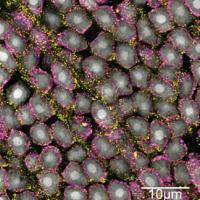
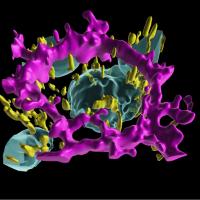
National Eye Institute (NEI) researchers have developed a digital replica of crucial eye cells, providing a new tool for studying how the cells organize themselves when they are healthy and affected by diseases.
A new study challenges the traditional understanding of disease genetics for IRDs and other rare genetic diseases according to the researchers, and may have implications for the clinical use of genetic testing and the development of new treatments.
A new study spearheaded by investigators at Scripps Research and the National Eye Institute offers compelling evidence that vision loss from macular telangiectasia can be slowed with a neuroprotective surgical implant.
During most eye infections or injuries, neutrophils, immune cells found in the blood, are usually the first line of defense. However, new research shows retina responds differently than other tissues in the body.
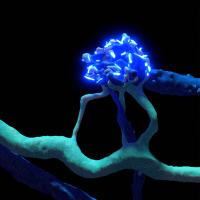
A National Eye Institute-funded research team at the University of Minnesota Medical School discovered that a cancer signaling pathway has previously unrecognized roles in retina and brain blood vessels.
Researchers at the National Institutes of Health (NIH) have identified which brain circuits are vital for visual acuity and how they are affected by damaged retinal cells.
Scientists at the National Institutes of Health (NIH) have leveraged artificial intelligence to transform a device designed to see tissues in the back of the eye into one sharp enough to make out individual cells.
Brown University researchers have identified a promising new approach that may help to restore vision in people affected by macular degeneration and other retinal disorders.