Thanks to the work of NEI scientists and grantees, we’re constantly learning new information about the causes and treatment of vision disorders. Get the latest updates about their work — along with other news about NEI.
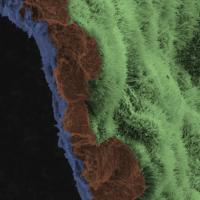
Cells of the retinal pigment epithelium (RPE) form unique patterns that can be used to track changes in this important layer of tissue in the back of the eye, researchers at the National Eye Institute (NEI) have found.
A team of researchers led by Harvard's Joshua Sanes applied high-throughput genetic sequencing methods to create the first cellular atlas of the primate retina.
National Eye Institute scientists led a collaborative study and zeroed in on genes associated with age-related macular degeneration (AMD), a leading cause of vision loss and blindness among people age 65 and older.
A team of researchers has discovered how the brain uses tiny, unconscious eye movements to pick up differences in brightness, likely by “refreshing” signals hitting the retina.
Using a novel patient-specific stem cell-based therapy, researchers at the National Eye Institute (NEI) prevented blindness in animal models of geographic atrophy, the advanced “dry” form of age-related macular degeneration (AMD)...
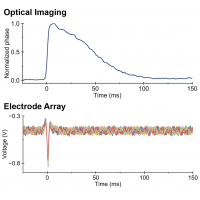
Researchers at Stanford University, Palo Alto, California, have created a noninvasive technology that detects when nerve cells fire based on changes in shape.
The National Eye Institute (NEI) awarded $25,000 to a team led by Wei Liu, Ph.D., Albert Einstein College of Medicine, for demonstrating progress toward the development of a living model of the human retina...
By combining two imaging modalities—adaptive optics and angiography—investigators at the National Eye Institute (NEI) can see live neurons, epithelial cells, and blood vessels deep in the eye’s light-sensing retina.