
Thanks to the work of NEI scientists and grantees, we’re constantly learning new information about the causes and treatment of vision disorders. Get the latest updates about their work — along with other news about NEI.
Studying mice, researchers at Washington University School of Medicine in St. Louis have found that proteins made by stem cells that regenerate the cornea may be new targets for treating and preventing corneal injuries in people with dry eye.
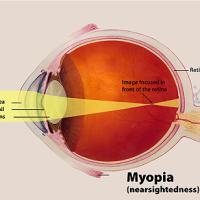
Myopia is a leading cause of vision impairment worldwide and is growing in prevalence, this study aims to provide a deeper understanding of the biology of myopia that will lead to new and more effective treatments.
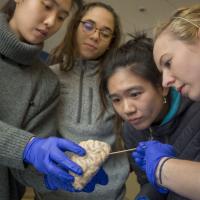
A team of engineers and neuroscientists has demonstrated for the first time that human brain organoids implanted in mice have established functional connectivity to the animals’ cortex and responded to external sensory stimuli.
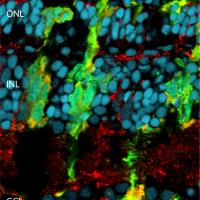
Research from University of Michigan scientists reveals Vegf-Notch signaling system that is activated in the injured retina, gives Muller glia stem cell properties.
An international team led by Harvard Medical School scientists has discovered a new genetic mutation that may be a root cause of severe cases of childhood glaucoma, a devastating condition that runs in families.
A pilot study of 106 patients with “wet” AMD revealed that nearly half of patients treated with Eylea could safely stop therapy after one year, compared to only 17% of patients treated with Avastin.
A new study from Duke University finds that single neurons conveying visual information about two separate objects in sight do so by alternating signals about one or the other.
Researchers from the University of Illinois shed light on how neural stem cells called neuroblasts divide multiple times to sequentially produce neurons of specialized function.
Jordan Hamm, an assistant professor of neuroscience at Georgia State University, has received a five-year, $1.93 million award from the National Eye Institute.