


Thanks to the work of NEI scientists and grantees, we’re constantly learning new information about the causes and treatment of vision disorders. Get the latest updates about their work — along with other news about NEI.
Johns Hopkins researchers have developed a method to efficiently turn human stem cells into retinal ganglion cells, the type of nerve cells located within the retina that transmit visual signals from the eye to the brain.
Because sound travels much more slowly than light, we can often see distant events before we hear them. That is why we can count the seconds between a lightning flash and its thunder to estimate their distance.
Researchers have used fruit flies and mice to make novel discoveries about sensory physiology at both cellular and molecular levels that are important for light processing.
Researchers at Johns Hopkins and the University of Washington report new research that sheds light on how the retina sets its own biological rhythm using a novel light-sensitive pigment, called neuropsin, found in nerve cells at the back of the eye.
When we move our head, the whole visual world moves across our eyes. Yet we can still make out a bee buzzing by or a hawk flying overhead, thanks to unique cells in the eye called object motion sensors.
Spider-like cells inside the brain, spinal cord and eye hunt for invaders, capturing and then devouring them. These cells, called microglia, often play a beneficial role by helping to clear trash and protect the central nervous system against infection.
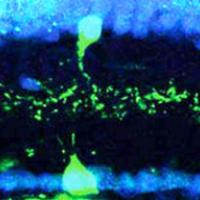
Researchers at Washington University School of Medicine in St. Louis have identified a neural circuit in the retina that enable the eye to detect movement.
Much like the automatic focus of a camera, our eyes and brains must constantly recalibrate so that we can get a clear view of the changing—and always moving—world around us.
Through a clinical collaboration, a 34-year-old paralyzed from the neck down is the first person in the world to have a neural prosthetic device implanted in a region of the brain where intentions are made.
New research, published online May 7 in the journal Neuron, describes how axons of specialized nerve cells find their way through the brain’s maze of neurons to make the right connection.